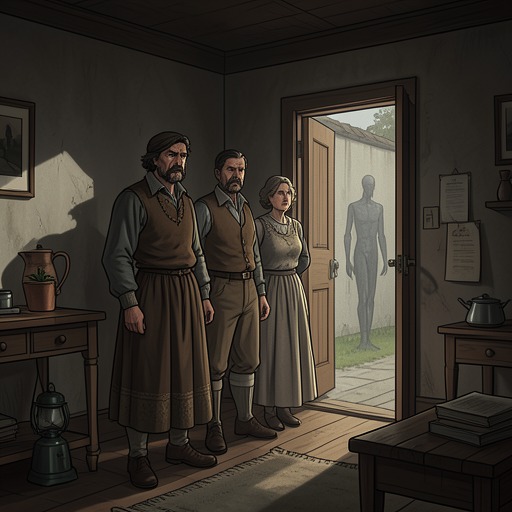
The Gardner Family's Decline
The Colour Out of SpaceThe Gardner Family's Decline is the slow destruction of Nahum Gardner’s household as an alien influence spreads through the farm’s vegetation, water, animals, and finally the people themselves. Its horror lies not in one sudden catastrophe but in the family’s repeated attempts to treat each new symptom as manageable: move the cattle, endure the bad harvest, lock away the sick. By the time the danger becomes legible, the household has already been reduced to isolation, bewilderment, and loss.
A Farm Gradually Changed
The decline becomes visible first in the environment around the Nahum Gardner farm. By the time Ammi Pierce’s visits were growing rare, the grass and leaves had begun to turn gray and brittle. The family’s surroundings no longer behaved like ordinary living things, and their physical and mental deterioration advanced alongside the changes in the plants. When school closed, the Gardners were nearly cut off from the world; sometimes they relied on Ammi to run errands in town. Their isolation was not simply a consequence of illness. It left them increasingly alone with a danger they could neither identify nor explain.
The family’s attempts to manage the damage brought only temporary relief. When the cows’ milk became bad, Nahum moved the animals to the uplands, and the immediate trouble stopped. But the grass and leaves soon showed the blight openly, and by September the vegetation was crumbling into gray powder. Ammi noticed that the well water tasted wrong and advised Nahum to dig another well on higher ground. Nahum ignored him. By then, repeated exposure to strange and unpleasant changes had worn down his resistance; he and the boys continued to drink the water and eat meager, poorly prepared meals. Their days of thankless chores acquired the air of a routine continuing after its ordinary purpose had vanished.
The animals’ deterioration made the spread harder to dismiss as a problem confined to a single crop or grazing field. Poultry turned gray and died quickly; their meat was dry and foul. Hogs grew abnormally fat before becoming gray, brittle, and altered, while the cows suffered shriveling and collapse. The animals died even though the cases occurred in a locked barn, and the hogs had not been fed the tainted vegetation. The dogs disappeared, and the cats had already left. With no livestock or poultry surviving by harvest, the farm’s familiar sources of food and labor were gone as well. The pattern resisted ordinary explanation, while the family’s shrinking ability to seek help made each loss more consequential.
Illness and Confinement
In June, near the anniversary of the meteorite’s fall, Mrs. Gardner began screaming about things in the air that she could not describe. Her speech offered motion and change rather than identifiable objects: things moved, fluttered, and shifted, while sensations reached her that were not quite sounds. Nahum let her wander so long as she seemed harmless. When her expression changed and the boys became afraid, he locked her in an attic room. By July she had stopped speaking and crawled on all fours; Nahum thought she had begun to glow faintly in the dark, like the nearby vegetation.
Thaddeus’s illness followed a visit to the well. He returned without the water he had gone to fetch, shrieking, gesturing wildly, and sometimes whispering about moving colors below. Nahum allowed him to run about for a week, until his stumbling and injuries led his father to confine him in another attic room across the hall from his mother’s. Their cries through the locked doors frightened Merwin, the younger boy, who imagined they were speaking a terrible language not of Earth. The household’s effort to contain illness therefore became another source of fear: the children were separated from one another, and Merwin lost the brother who had been his closest playmate.
Losses Inside the Household
On October 19, Nahum came to Ammi’s house with news that Thaddeus had died in his locked attic room. The door and barred window were intact, but Nahum could not explain what had happened. He buried what he had found in the family plot behind the farm. A few days later, Merwin went out at night with a lantern and pail to fetch water and did not return. A shriek came from the yard; Nahum reached the door too late to see what had taken place. After searching through the night, he found near the well the crushed, partly melted remains of the lantern and the bent, half-fused iron hoops of the pail. There was no trace of the boy.
Nahum could offer no remedy or coherent account. He told Ammi that Thaddeus was gone and Merwin was gone, and asked him to look after Mrs. Gardner and Zenas if they survived him. He interpreted the disaster as judgment, though he could not think of anything he had done to deserve it. That explanation did not resolve the mystery; it expressed a desperate need to place the family’s suffering inside a moral order even as the evidence offered no clear reason for it.
Nahum’s Revelation and the Meaning of the Decline
After more than two weeks without seeing Nahum, Ammi returned to a farm drained of its former life: the grass and leaves were withered, vines crumbled from the old walls, and bare trees seemed to reach against the November sky. Nahum was alive, weak on a couch in a cold kitchen, and still able to give Zenas simple instructions. Asked about the missing boy, he could say only that Zenas was in the well. Asked about his wife, he insisted she was there, though Ammi had to search the house himself. Nahum’s failure to recognize what had become of his family marked a further collapse of his grasp on events.
Nahum’s final account, delivered as his body was breaking down, connected the household’s losses to the well and to the colored presence that had first affected the plants. He said it had lived in the well, that its influence had poisoned the farm, and that it drew the life from living things. He associated it with the strange sphere the college men had broken out of Nahum Gardner’s meteorite and believed there might have been more of them, like seeds that had grown. He also recalled that Zenas had not returned from the well and warned that the water drew people toward it. His explanation came too late to save the family: while Ammi listened, Nahum’s body collapsed into dry, brittle fragments.
The family’s decline thus makes the farm itself the record of an expanding assault. Gray vegetation, spoiled food and water, dead animals, locked rooms, and missing children arrive in stages, each change narrowing the survivors’ choices. The source remains alien to ordinary categories, but its consequences are concrete: the household loses health, companionship, livelihood, and finally its ability to distinguish the living from the lost. Nahum’s recognition of the well’s role gives the sequence a cause, not a rescue or a way back.